
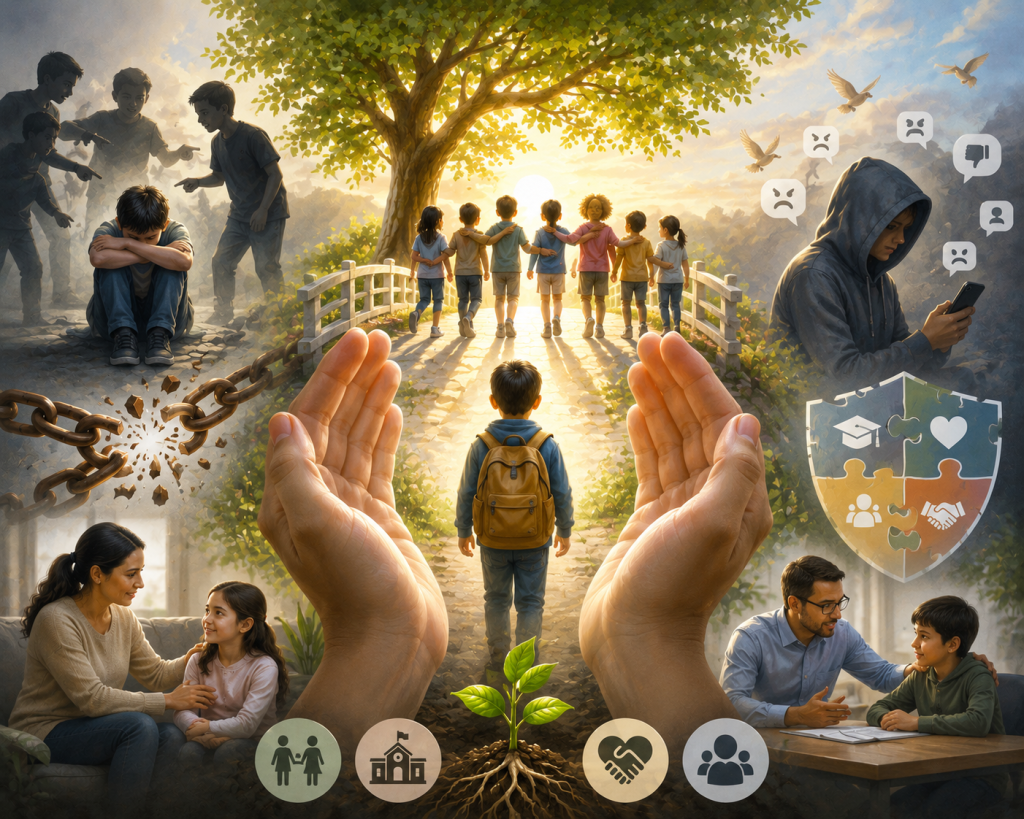
As children spend a significant amount of their time in school, it is often seen as a special place for learning, development, and socialization. Children typically spend six to eight hours at school, where they learn, develop social skills, and engage in extracurricular activities. Children spend an average of six to eight hours per day in school, engaged in academic, social, and extracurricular activities that significantly impact them intellectually, emotionally, and socially. Ideally, schools are places where children can thrive, but for some, the experience includes distressing experiences, such as bullying, that impact negatively upon their well-being and learning.
Schools are becoming diverse in the United States in terms of ethnicity, language, culture, and socioeconomic status. Children from diverse family and cultural backgrounds may exhibit different behavior and communication styles in educational environments. While diversity is a valuable asset in the school community, it can undermine understanding, lead to peer exclusion and/or conflict if it is not understood and respected (National Center for Education Statistics [NCES], 2024). If a person does something that is harmful by intent, it is repeated, and one person has more power, it may be considered bullying (Centers for Disease Control and Prevention [CDC] 2024). These experiences can have a detrimental impact on children’s emotional well-being, self-esteem, educational success, and mental health. It is also essential to recognize that not all conflicts or poor interactions between pupils are acts of bullying.
Understanding Bullying in Schools
Bullying is typically described as the persistent aggressive behavior of one or more individuals against another person or group of people, with the intent of causing the other to feel threatened, hurt, humiliated, or controlled by the aggressor(s) (Olweus, 1993). Bullying in schools may take a variety of forms and can be overt or covert, both in the real world and online (CDC, 2024; U.S. Department of Education, 2023).
Physical bullying is when someone is physically harmed on purpose, including being physically pushed, hit, kicked, tripped, or having their belongings damaged. Verbal bullying is teasing, insulting, name-calling, mocking, threatening, or humiliating words that affect the child emotionally. Social bullying (or relational aggression) is when a person excludes
Students making rumors about peers can damage friendships and reputations. Cyberbullying is a common form of bullying today, and it can consist of offensive social media posts, harmful text messages, sharing of embarrassing content to shame or isolate a student, online threats or other forms of cyberbullying (UNESCO, 2019).
The responsibility to prevent bullying is shared by all of those with whom the student comes into contact in the home, school, and community (Espelage & Swearer, 2011). Children who are bullied may change their behavior or emotions, which could be quite noticeable at first. It is important for parents and educators to watch for signs of sadness, social isolation, poor school performance, worry, fear, and school avoidance. Bullying that goes unaddressed can have serious psychological repercussions, which can include stress, depression, emotional trauma, and low self-esteem (CDC, 2024; Hinduja & Patchin, 2018).
1. Build confidence in children and emotional resilience.
A key measure to prevent bullying is to help children develop confidence and emotional resilience. Self-confidence in children can lead to them feeling more empowered to express their problems, set boundaries, and ask for help if needed. By engaging in activities like karate, taekwondo, sports, music or leadership training, children can develop discipline, self-control and confidence and gain emotional maturity (Bandura, 1997).
It is also important that parents support children to be confident in their self-expression while respecting others. For example, if a child faces an insulting comment, they can be encouraged to assert themselves instead of responding emotionally. It’s important to teach kids that they can be confident without being aggressive, which can help them to handle tough situations better.
2. Open Communication and Emotional Support are maintained.
Parental/children communication is a protective factor against bullying (CDC, 2024). If children feel safe and secure in their home, they’ll be more willing to share negative experiences and will likely ask for assistance when they are faced with challenging or stressful times. Thus, parents need to establish a safe space for children to express what is happening to them at school (UNESCO, 2019).
Emotional trust can be greatly affected in simple, everyday conversations. Children can feel heard or valued by being asked reflective questions, like “How was your day?” or “Was there anything you didn’t like about this day today?” Moreover, parents should listen without judgment, in an emotionally safe environment, without fear of punishment or dismissal.
3. Knowledge and application of School Policies
Parents should be aware of the school’s anti-bullying policies and support school leaders in implementing them when a bullying incident occurs (U.S. Department of Education, 2023). Schools are a key component in the early detection and intervention of bullying via systems, counseling and discipline.
For instance, if there is a case of cyberbullying, parents should record the negative communication, keep the evidence, and let teachers or school administrators know right away. Many schools have put in place confidential reporting systems and safe-reporting systems to ensure that students can report incidents of bullying without fear of repercussions.
4. Educating in Safe and Responsible Online Behavior
Digital safety education is now a critical component of bullying prevention (Hinduja & Patchin, 2018) as children spend more and more time online. There should be an appropriate discussion of responsible technology use, online privacy and how to protect personal information between parents and schools and in the classroom.
It is also important for children to understand that inappropriate contacts online and messages that are suspicious or threatening should be reported to a trusted adult. Being able to block problematic accounts, report bullying, and be digitally responsible can drastically decrease risk of cyberbullying (American Psychological Association [APA], 2023).
5. Building Friendships and Social Relationships
Positive peer relationships and healthy friendships are protective against bullying (Wentzel et al., 2021). Children in inclusive friendship groups have a better chance of feeling emotionally safe, more confident and a sense of belonging in their school setting.
Parents are encouraged to support children to engage in clubs, sports, arts and other extension activities that foster team working and social interaction. Being a part of a group can often foster a sense of belonging and lessen the sense of isolation which can make some children more susceptible to bullying.
6. Identifying and responding to bullying behaviors
Children need to be educated on what to see when a bully is present and what to do about it (Olweus, 1993). They need to be aware that it is not acceptable to treat others with repeated mistreatment, intimidation or humiliation, or to accept it quietly.
Children can learn to assert themselves and set personal limits by learning assertive communication. Some children, for instance, may be taught to say, “I don’t like what you are doing; please stop. Some children, for instance, may be taught to say, “I don’t like what you are doing; please stop. Further, it is important that children seek support from trusted adults, teachers, counselors, or parents if it happens to be a problem of bullying.
Additionally, bystanders need to be enabled to assist the victim and safely report the incident, rather than remain silent witnesses.
7. Promoting Family-School Partnerships
Bullying prevention must be an ongoing partnership of parents, teachers, counselors and school administrators (Espelage & Swearer, 2011). Schools should conduct awareness-raising sessions, anti-bullying sessions, parent-teacher consultations, and empowering sessions for students on a regular basis to promote empathy, inclusion, and respectful behavior.
Peer-support systems, classroom relationship-building activities, and school initiatives like “Friendship Days” can also be implemented to promote positive student relationships and decrease social isolation in schools.
8. Professional Support as needed
Consider professional intervention when children continue to show emotional distress, fear, depression, school avoidance, and/or social withdrawal (APA, 2023; CDC, 2024). School counselors, psychologists and mental health professionals can deliver emotional support and evidence-based interventions, which can help children regain confidence and resilience.
Early intervention is crucial as it is a period when unresolved incidents of bullying can have an impact on emotional health and wellbeing throughout the adolescent and adult years.
Conclusion
There is a need for a comprehensive and supportive response to bullying prevention, which includes confidence-building, emotional support, parental involvement, positive peer relationships, school accountability, and community engagement (UNESCO, 2019; CDC, 2024). A school should be safe and supportive and all children feel respected, protected and valued.
Parents, educators and communities are all responsible for supporting children to face challenges with courage and emotional resilience. Educating children in safe learning environments that promote open communication, empathy, and response to bullying helps them succeed academically, socially, and emotionally.
References
American Psychological Association. (2023). Bullying and child mental health. https://www.apa.org
Bandura, A. (1997). Self-efficacy: The exercise of control. W.H. Freeman.
Centers for Disease Control and Prevention. (2024). Preventing bullying. https://www.cdc.gov
Espelage, D. L., & Swearer, S. M. (2011). Bullying in North American schools (2nd ed.). Routledge.
Hinduja, S., & Patchin, J. W. (2018). Connecting adolescent suicide to the severity of bullying and cyberbullying. Journal of School Violence, 18(3), 333–346.
National Center for Education Statistics. (2024). Status and trends in the education of racial and ethnic groups. U.S. Department of Education.
Olweus, D. (1993). Bullying at school: What we know and what we can do. Blackwell Publishing.
UNESCO. (2019). Behind the numbers: Ending school violence and bullying. UNESCO Publishing.
U.S. Department of Education. (2023). Preventing and addressing bullying in schools. https://www.ed.gov
Wentzel, K. R., Russell, S., & Baker, S. (2021). Peer relationships and positive school adjustment. Educational Psychologist, 56(3), 215–229.
Author Note
Dr. Hari Uprety is a lyricist, researcher, author, and community leader whose work focuses on cultural identity, education, diaspora studies, and social well-being. As the founding president of the International Nepali Lyricist Association, Inc. (INLA), he is committed to preserving and promoting Nepali language, literature, and lyrical traditions across global communities. Dr. Uprety’s research interests include cultural preservation, immigrant experiences, children’s well-being, and the role of music and literature in strengthening identity and belonging. Through his writing, he seeks to raise awareness of social issues and contribute to meaningful dialogue that supports stronger families and communities.